(NB Links may be affiliate links. See my disclosure here)
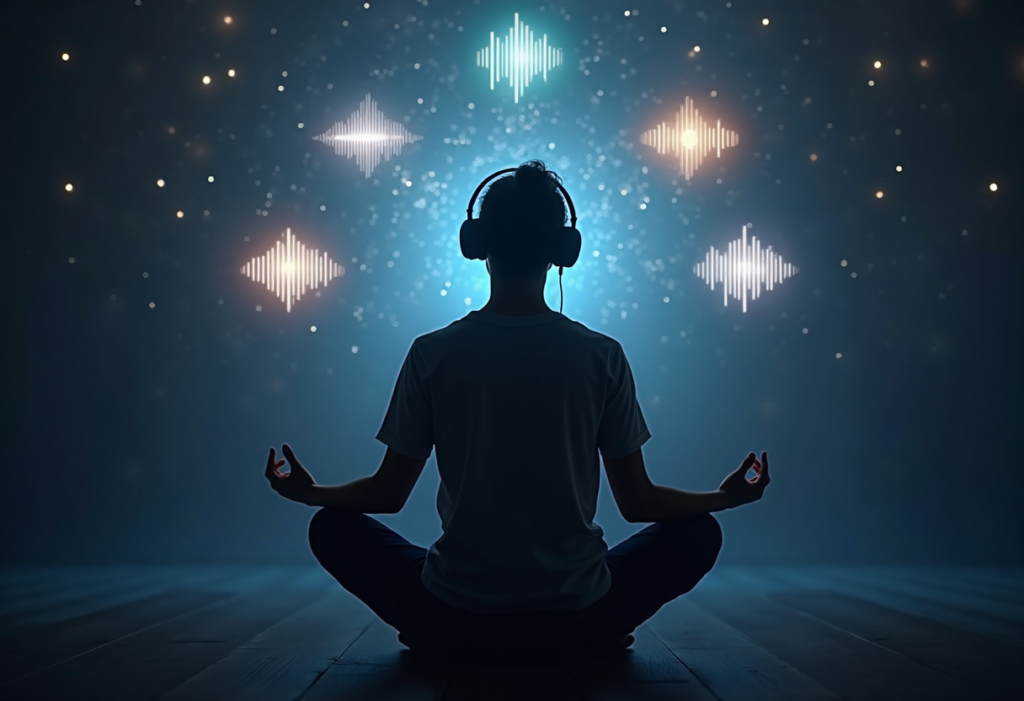
How Do Binaural Beats Work? And How They Can Influence Your Mind and Mood?
Ever Wonder What Your Brain Sounds Like?
Inside your skull, a silent symphony plays with electrical pulses flickering across billions of neurons.
Scientists call them brainwaves. You might just call it your “mood,” your “focus,” or your “state of mind.”
Turns out, these waves aren’t just background noise. They’re tunable. And binaural beats might be the dial.
First, Let’s Talk Brainwaves
Your brain operates on frequencies.
From deep, slow waves that cradle you in sleep to rapid-fire rhythms that spark creativity, these brainwaves shape how you think, feel, and act.
Here’s a quick tour:
Delta (0.5–4 Hz): Think deep sleep and healing.
Theta (4–8 Hz): Daydreaming, meditation, emotional digging.
Alpha (8–12 Hz): Calm focus, that “flow” feeling.
Beta (12–30 Hz): Productivity, logic, outward focus.
Gamma (30+ Hz): Consciousness, memory, flashes of insight.
Each frequency band represents a different you.
And when you learn to shift between them, you’re not just managing your mind, you’re mastering it.
So… How Do Binaural Beats Work?
Imagine this: One ear hears a 200 Hz tone. The other hears 210 Hz.
Your brain doesn’t hear both but instead creates a new sound, a “beat” at 10 Hz.
That 10 Hz beat?
It’s not real. It’s not coming from your headphones. Your brain invented it.
And here’s the point to note: that invented rhythm nudges your brainwaves toward 10 Hz.
That’s how binaural beats work: They whisper a suggestion your brain tends to follow.
The name for this is brainwave entrainment, and it’s like training your brain to dance to a different tune.
Literally.
Read my more detailed article to get up to speed with it.
What Science Says — And Doesn’t
Let’s get honest: Binaural beats aren’t miracle tones. But they’re not snake oil either.
Early studies — and there are more all the time — suggest they help:
Increase focus when tuned to beta waves
Relax the mind using calming alpha rhythms
Deepen sleep by engaging delta waves
Enhance meditation via theta-state immersion
Some people swear they’ve never been more creative. Others use them to wind down from anxiety.
Still, results vary. Why? A few culprits:
Bad headphones (they need stereo separation)
Wrong frequency (alpha when you needed beta)
No consistency (you can’t hit flow in 3 minutes)
Too many distractions (scrolling Instagram cancels the effect)
Binaural beats aren’t passive magic. They’re subtle tools. You have to show up with intention.
Want to Try Them? Start Here.
Here’s a no-fluff starter guide to getting the most out of binaural beats:
🧠 Choose Your Goal
Focus? Beta or low gamma – Try Nitrofocus
Relaxation? Alpha – Try Zen12
Sleep? Delta – Try Sleep Salon
Creativity or intuition? Theta – Try Brain Evolution System
🎧 Use Real Headphones
Not your laptop speakers. Not your AirPods in mono mode.
You need stereo so you get one frequency per ear.
See my recommendation and the reasons why in my article here.
📱 Pick a Good Source
Apps: Brain.fm, Insight Timer, Brainwave Club
YouTube Channels: I don’t listen to Youtube binaural beats. I don’t know who has made them, what is in them and there is no comeback for the producer of the audio.
- iAwake produce superior quality audios and have an excellent app for convenience and some free samples.
📅 Make It a Ritual
Try 20 minutes a day.
Maybe during journaling. Or before sleep. Or first thing in the morning.
You’ll feel it build over time. Like slowly rewiring, not flipping a switch.
The Future Is Getting Sonic
What’s coming next?
AI-generated frequencies personalized to your mood
VR meditation rooms with spatial binaural audio
Neurotherapy sessions using sound instead of pills
Wearables that adapt beats in real time as your brain shifts
Binaural beats aren’t a fad. They’re part of a bigger wave.
It’s one that blends neuroscience, mindfulness, and tech.
FAQs – Answering the Voice in Your Head
Do I need special gear?
Yes. Stereo headphones are a must. Otherwise, no beat, no brainwave shift.
How fast will I feel it?
Some feel it in 5 minutes. Others need a week. Relax and trust the process.
Is it safe?
It is generally safe as the brainwave states are totally natural. However, some people are advised not to listen, such as epileptics, pregnant women and children. Always follow the producer’s guide and instructions.
Can I use them while working or driving?
I don’t listen while driving or using any machinery or tools.
In theory you could as long as you’re using alertness frequencies like beta and I do if I’m writing or doing office work.
Other frequencies may make you sleepy or drowsy.
Try This:
Listen to 10 Hz theta beats before bed for a week and track your sleep quality.